


Performance Marketing INDIA · 2026 EDITION Do AI Influencers Actually Convert? What We Learned Running ThemBloomX EditorialPerformance Marketing📅 September 2026⏱
A D2C founder in Mumbai asked us in August whether she should move her store off WooCommerce. She was doing roughly 400 orders a month. Her developer had quit in June. Her product pages took nine seconds to load on 4G, and her Diwali campaign was six weeks out.
She didn't want a feature comparison. She wanted to know what would still be standing in March.
That's the actual question hiding inside every Shopify vs WordPress India search. Not which platform wins on paper, but which one your team can run for three years without a developer permanently on retainer. Here's how we work through it with clients.
Shopify's pitch is simple. You get hosting, PCI compliance, a CDN, a checkout that converts, and an app store for everything else. A small team can launch in two weeks.
The Shopify India cost picture deserves a closer read, though. On annual billing, Basic runs about ₹1,499 a month, Grow about ₹5,599, and Advanced about ₹22,680. Add 18% GST on top of every one of those. Then add the part most founders miss: Shopify Payments isn't live in India, so you route payments through Razorpay, PayU or CCAvenue and pay Shopify a platform transaction fee of roughly 2% on Basic, 1% on Grow and 0.5% on Advanced, on top of whatever your gateway charges. Layer in four or five paid apps for reviews, upsells, COD verification and shipping, and a Basic store realistically lands somewhere between ₹4,000 and ₹8,000 a month.
Where it pinches: the checkout is locked unless you're on Plus, URL structures are rigid, and your app stack quietly becomes a monthly subscription pile you can't easily audit. You're renting a very good machine you'll never own.
WordPress with WooCommerce flips the trade. No platform transaction fee, no app store tax, full control over URL structure, schema, page templates and data. If you already publish content seriously, WordPress remains the most flexible editorial system available.
You're also now the sysadmin. Hosting, PHP versions, plugin conflicts, security patching, malware cleanup and backups are yours. We've inherited WooCommerce builds running 38 active plugins where three of them were doing the same job and one hadn't been updated in two years. That store wasn't slow because WooCommerce is slow. It was slow because nobody owned it.
WooCommerce makes sense when content and commerce genuinely share a site, when you need custom pricing or B2B logic, or when your catalogue has odd requirements no Shopify app handles cleanly. Budget for a maintenance retainer from day one. If you can't, pick Shopify.
Headless splits the storefront from the backend. Next.js renders the front end, while Shopify's Storefront API or a headless CMS like Sanity handles data. Done well, you get near-instant page transitions, clean Core Web Vitals and total design freedom.
Done badly, you get a beautiful site nobody in marketing can edit.
Headless commerce India is a real category now, mostly among brands past ₹5 crore in annual revenue with in-house engineers. The honest cost isn't the build. It's the two developers you need permanently, the preview environments, the CI pipeline, and the fact that a one-line copy change on the homepage becomes a pull request. We've talked three clients out of headless in the last year. Two of them didn't have a single developer on payroll.
If your bottleneck is conversion rate or creativity, headless won't fix it. If your bottleneck is genuinely front-end performance at scale, it will.
Google doesn't rank platforms. It ranks pages it can crawl, render, understand and trust. Every platform on this list can rank, and every one can fail.
What actually decides it:
Rendering. Client-side JavaScript is the quiet killer. During a site audit this year we found animated stat counters that rendered as literal zeros in the raw HTML, so every proof metric on the site was invisible to Google and to ChatGPT. Next.js handles this well with server-side rendering, badly with pure client-side fetching. WordPress serves HTML by default, which is why it quietly wins this fight more often than people expect.
URL control. WordPress and Next.js give you complete freedom. Shopify forces /products/ and /collections/ patterns, and collection-nested product URLs create duplicate paths you have to canonicalise.
Structured data. Article, Product, FAQPage and BreadcrumbList schema all matter more now that AI engines are parsing pages for citations. WordPress handles this through RankMath or Yoast. Shopify usually needs theme edits or an app. Next.js needs a developer.
Editorial velocity. The platform your content team will actually publish on twice a week beats the technically superior one they avoid. This is the criterion nobody scores and everybody feels.

Ignore the platform for a moment and answer four questions honestly.
Who edits the site on a Tuesday afternoon? If the answer is a marketing executive with no code access, that rules out headless immediately.
What's your order volume, and where's it going in 18 months? Under 50 orders a day, Shopify's transaction fee costs less than a developer retainer. Well past that, the maths starts to flip.
Is content a channel or a checkbox? If you're building a blog cluster to win organic and AI citations, WordPress earns its keep. If you're winning on paid social and creative, a hosted store is plenty.
What's your launch deadline? This one settles more debates than any other.
Two client builds show how differently that plays out. When we launched Poppy Eyewear, a new D2C label under the house behind Opium Eyewear, the brand had zero digital infrastructure and a fashion calendar it had to hit. We built a mobile-first store with collection filters, COD, guest checkout and a one-step cart, then put the energy into creative and funnel rather than infrastructure. Website work alone drove a 10x traffic increase in the first month, early campaigns delivered 4x transactions and 2x ROAS during launch, and the brand moved 10,000 units in a single month.
RMAS, a Mumbai enterprise risk and compliance consultancy, needed the opposite. No ecommerce, but 10+ compliance-heavy service areas to structure, an enterprise credibility problem, and a 15-day deadline. We built 15+ pages on a structured CMS with a 12-column responsive grid, tested across four breakpoints, and shipped in 14 days with first-pass client approval. Same agency, same year, completely different platform logic. The deciding factor was never the tech. It was who needed to edit what, and how fast.
Most replatforming disasters aren't platform failures. They're migration failures.
Before you move anything, export every indexed URL from Search Console and crawl the live site. Map old URLs to new ones, one by one, and 301 redirect every single one. No chains, no loops, no lazy catch-all redirects to the homepage. Carry your schema across along with your copy. Keep the old site's title tags and H1s intact on the new build until rankings stabilize, then optimize.
Internal links are the step teams skip. Old links buried in blog copy will keep pointing at dead paths long after your redirects are live, and every hop costs you a little crawl equity. Fix them at the source. While you're there, verify your new sitemap submits cleanly, your analytics and conversion tracking fire on the new templates, and your GSC property covers the correct protocol and subdomain.
Then pick your timing. Don't migrate three weeks before Diwali, and don't migrate the same month you switch ad platforms. Expect a dip of two to six weeks even on a clean migration. Plan for it instead of panicking through it.
Shopify if you need revenue fast and don't have a developer. WordPress if content is a real channel and you'll fund maintenance. Next.js if you have engineers on payroll and performance is the measurable constraint.
The founder from Mumbai stayed on WooCommerce, by the way. Her problem was an unmaintained plugin stack and no hosting plan, and none of that needed a replatform. Sometimes the right answer is to fix what you have and spend the rest on demand.

READY TO SCALE SMARTER
Stop guessing.
Start compounding.
Book a free strategy call with BloomX and see what AI-powered performance marketing can do for your ROAS – or explore what we’ve built for brands like yours.
Performance Marketing INDIA · 2026 EDITION Do AI Influencers Actually Convert? What We Learned Running ThemBloomX EditorialPerformance Marketing📅 September 2026⏱

Performance Marketing INDIA · 2026 EDITION Digital Growth for D2C Brands: The Poppy Eyewear by Opium Case Study BloomX Editorial
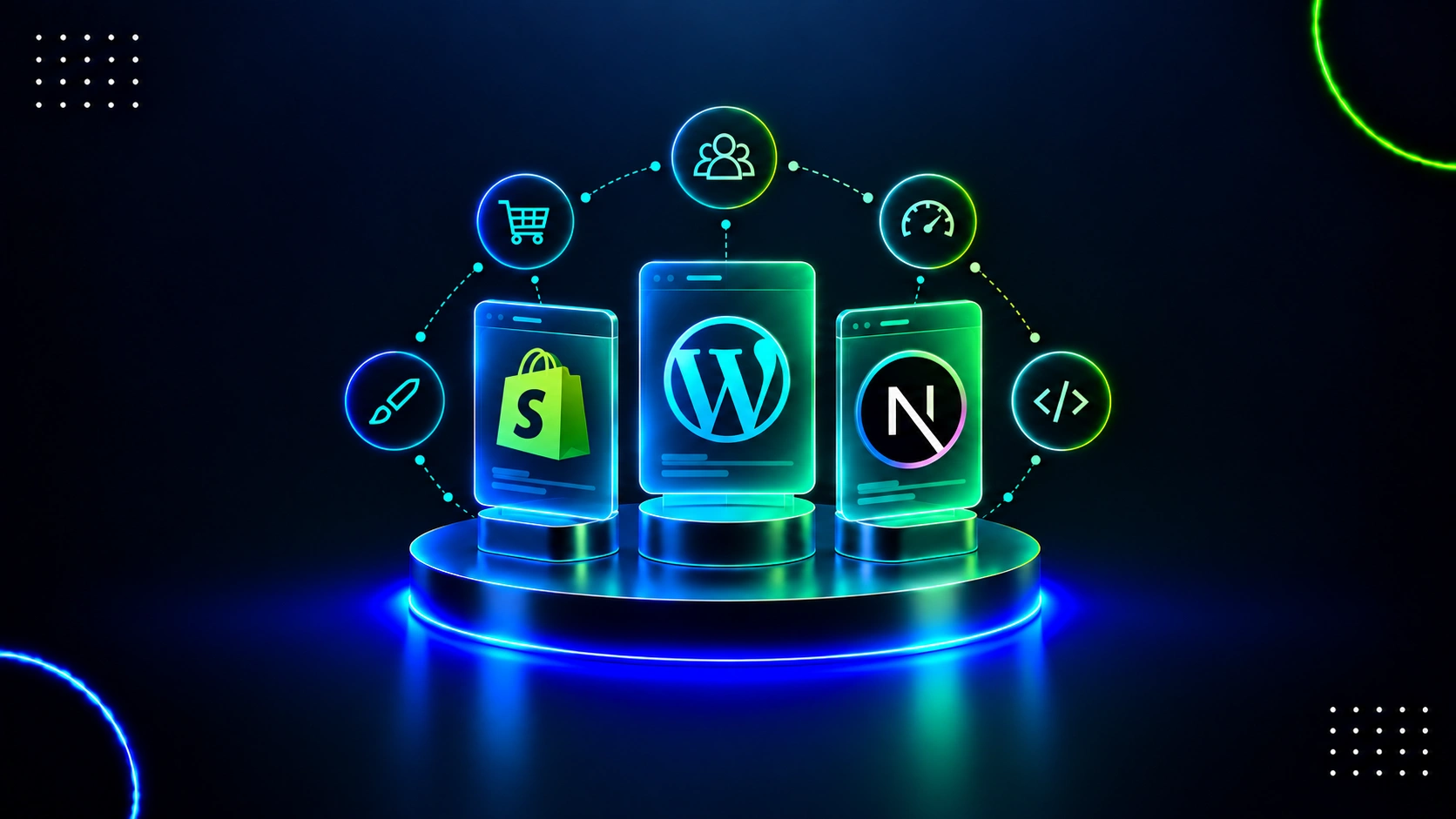
Web Development INDIA · 2026 EDITION Shopify vs WordPress vs Next.js: Choosing a Platform in 2026 BloomX Editorial Web Development